UDMG and USP in HA
UDMG and USP support High Availability (HA) deployments to maximize uptime, ensure resilience, and provide seamless continuity for business-critical environments. By deploying these products together in coordinated HA topologies, organizations can eliminate single points of failure and scale with confidence.
What is High Availability?
High Availability (HA) is an architectural approach where multiple redundant instances of a system component run in parallel. If one node or connection fails, others continue to provide service without interruption.
Key benefits include:
- Resilience: Protects against hardware, network, or process failures.
- Zero downtime: Failover or redistribution occurs seamlessly.
- Scalability: Traffic and workloads can be balanced across multiple servers.
- Operational continuity: Maintenance can be performed without service interruption.
HA in the Stonebranch MFT Suite
The UDMG + USP suite applies HA principles in both layers of the architecture:
- UDMG: Provides clustering of UDMG Server instances (Cluster Nodes) behind a load balancer, with a shared database as the single source of truth.
- USP: Provides Active/Active deployments of USP Server instances behind a load balancer (and, if needed, USP Client instances), ensuring secure session break and tunneling without interruption.
By combining these two HA layers, organizations can build an end-to-end secure file transfer architecture that is both fault-tolerant and highly scalable.
For detailed setup instructions, see UDMG High Availability and USP High Availability.
Architecture Overview
The following diagram illustrates a dual-layer HA deployment with USP Servers in the DMZ, USP Clients (optional) for firewall crossing, and UDMG Cluster Nodes sharing a common database inside the LAN.
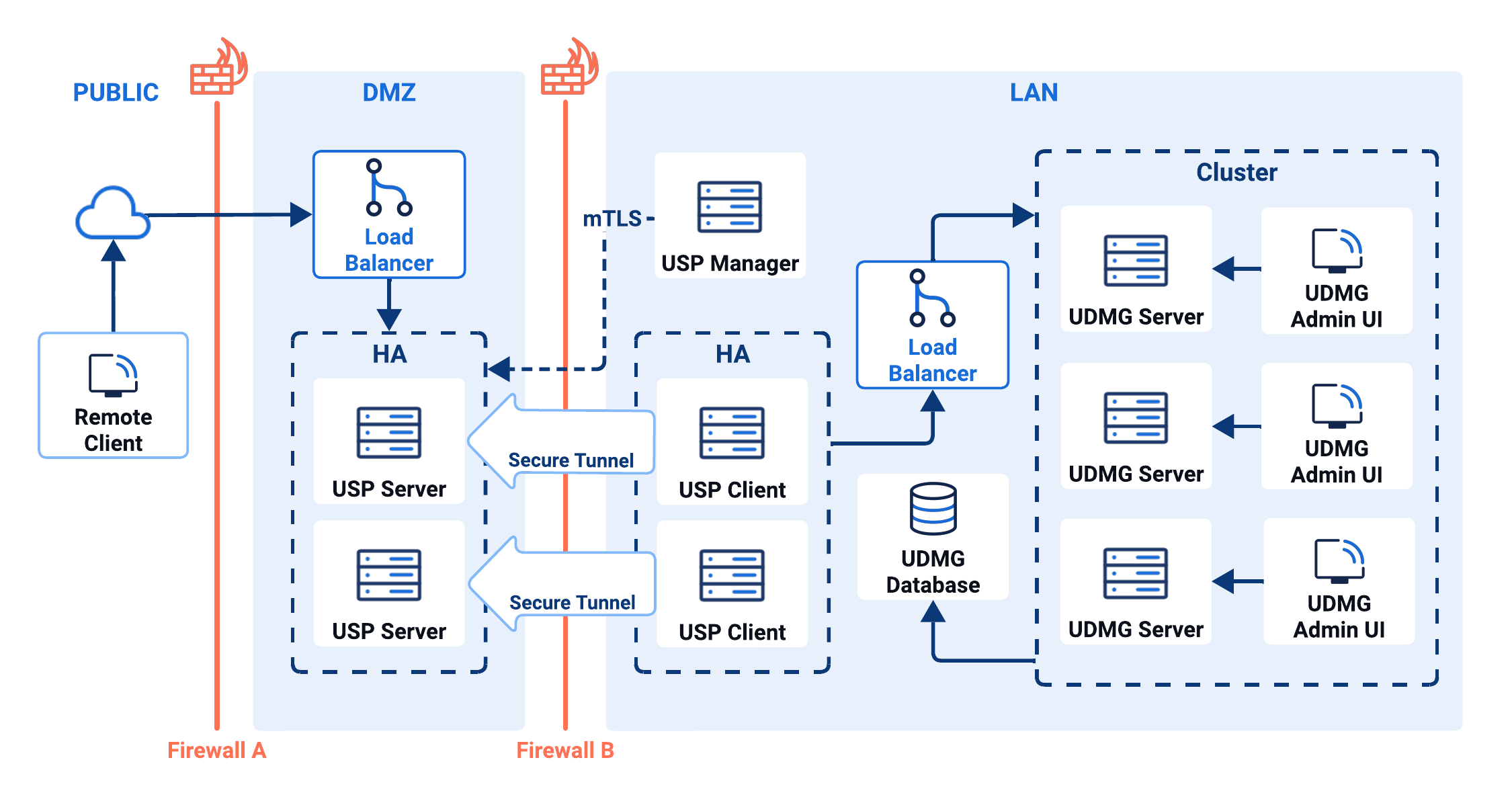
In this topology:
- External clients connect through a load balancer to multiple USP Server instances in the DMZ.
- USP Servers terminate inbound sessions and route traffic to the internal network.
- Optionally, USP Clients establish secure tunnels through firewalls when inbound connections are not permitted.
- Inside the network, another load balancer distributes traffic across UDMG Server instances (Cluster Nodes).
- All UDMG Cluster Nodes share a common database, ensuring consistent configuration and state.
This dual-layer HA model guarantees that both secure access (USP) and data movement (UDMG) remain highly available.
For production deployments, use Active/Active (A/A) mode in both USP and UDMG where possible, as it provides the strongest resilience and scalability.