AS2 Protocol
AS2 (Applicability Statement 2) is a widely adopted protocol for secure business-to-business (B2B) file exchange over HTTP or HTTPS. It supports encrypted, signed, and acknowledged transmission of EDI, XML, and flat files, ensuring confidentiality, integrity, and proof of delivery.
AS2 is a strictly one-way protocol: it sends data from one party to another and does not support retrieval. Each message is a push transaction, followed by an acknowledgment (MDN) sent either in the same HTTPS session or asynchronously at a later time. This design enhances auditability and reliability, making AS2 a standard in industries like retail, logistics, and supply chain operations where verifiable file delivery is critical.
AS2 is not suited for large files. See Large-File Limitations.
UDMG AS2 Implementation
UDMG Server supports AS2 communications in both directions:
- UDMG as an AS2 Server (or Receiver), to receive files from your partners.
- UDMG as an AS2 Client (or Sender), to send files to your partners' AS2 servers.
This flexibility allows UDMG to integrate with partners regardless of whether they need to send or receive files.
UDMG as AS2 Server
This configuration involves a Local AS2 Server to Local Filesystem Pipeline.
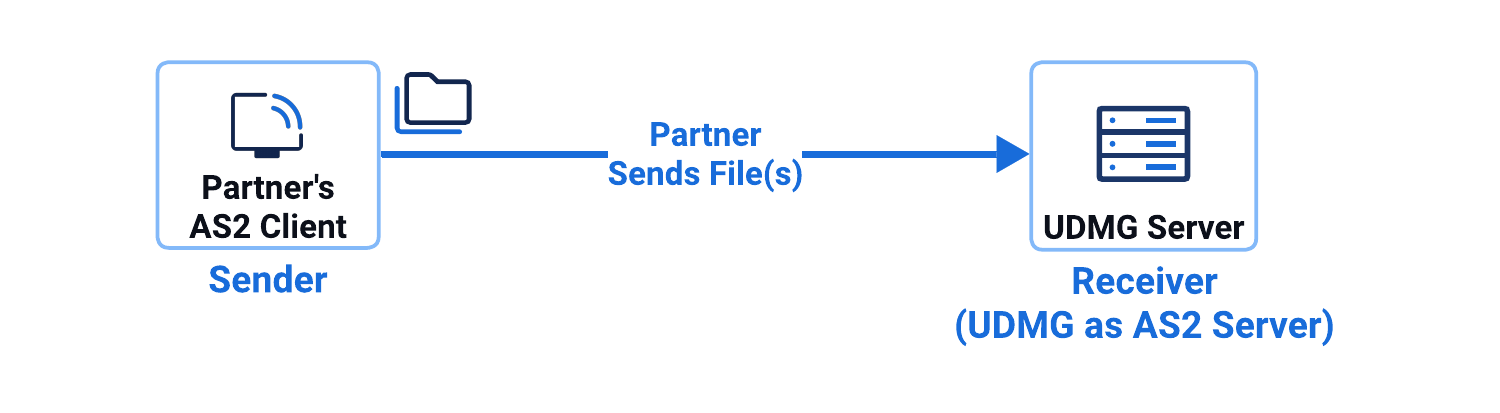
In this configuration:
- UDMG locally hosts a partner-specific Local AS2 Server Endpoint.
- Your partner uses an AS2 client to connect and authenticate to the Local AS2 Server Endpoint.
- UDMG receives signed and encrypted files from the external AS2 client.
- Files are decrypted, validated, and saved to a filesystem (defined in the Local Filesystem Endpoint).
- UDMG generates and returns a Message Disposition Notification (MDN) to confirm receipt.
UDMG as AS2 Client
This configuration involves a Local Filesystem to Remote AS2 Server Pipeline.
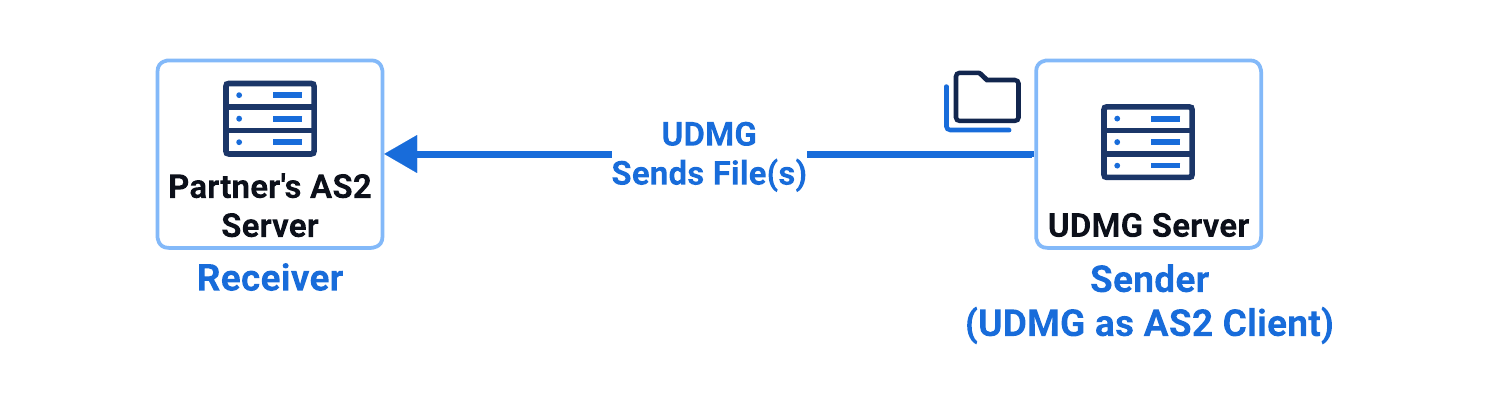
In this configuration:
- UDMG has access to a filesystem (defined in a Local Filesystem Endpoint).
- A UDMG Admin or automated process initiates an AS2 transfer through the Transfers Scheduled API. Files are compressed (if configured), signed, and encrypted before transmission.
- UDMG sends the file to your partner's AS2 Server.
- The partner's AS2 Server acknowledges receipt by returning an MDN (synchronously or asynchronously).
- UDMG validates the MDN and logs the transfer result in the Transfers Dashboard page.
Large-File Limitations
AS2 was designed for exchanging discrete business documents (EDI transactions, invoices, purchase orders) between trading partners. Every AS2 message is digitally signed and encrypted, and can optionally be compressed, with the same steps reversed on receipt. These cryptographic operations work against the complete message rather than a continuous stream, so both the sending and receiving systems hold the full file in memory at several stages of processing. As file size grows, so do the memory, CPU, and time required to sign, encrypt, decrypt, and verify the message within the connection's timeout window.
AS2 performs best with the small-to-moderate document sizes typical of B2B transactions. Very large files can drive processing time and resource usage high enough to cause transfer failures or partner-side timeouts. For regular large-file movement, a protocol built around streaming large payloads, such as SFTP or FTPS, is a better fit.