Local SFTP Server to Remote Cloud Storage
The Local SFTP Server to Remote Cloud Storage Pipeline type represents a server-based transfer scenario where UDMG acts as an SFTP server, accepts inbound connections from partners, and exposes a cloud storage location through a configured Pipeline.
Partners connect using their preferred client and transfer files based on a defined Pipeline configuration, which determines how files are handled once received. Configured permissions control which file and folder operations each partner can perform.
This Pipeline consists of:
- A Local SFTP Server Endpoint that receives incoming SFTP connections (used as the Source Endpoint).
- A Remote Cloud Storage Endpoint that represents the cloud storage location exposed through the Pipeline (used as the Destination Endpoint).
- Account-based authentication and authorization through Accounts and Account Groups.
- Pipeline-specific configuration options.
Unlike Pipelines in which UDMG acts as a client, transfers in this Pipeline type are automatically triggered by the UDMG Server when a partner performs an action. To enable this, the Pipeline must be assigned to at least one Account Group to grant access to the Account associated with that partner.
Before You Begin
Understanding Paths in This Pipeline
When configuring a Local SFTP Server to Remote Cloud Storage Pipeline, several path fields determine how files and directories accessed by external partners are mapped to locations in the cloud storage provider.
Each path has a specific role and is combined during runtime to build the final object key (or path) used in the selected cloud provider and object storage service. Regardless of the UDMG Server host operating system, the path must use forward slashes / (Linux path formatting).
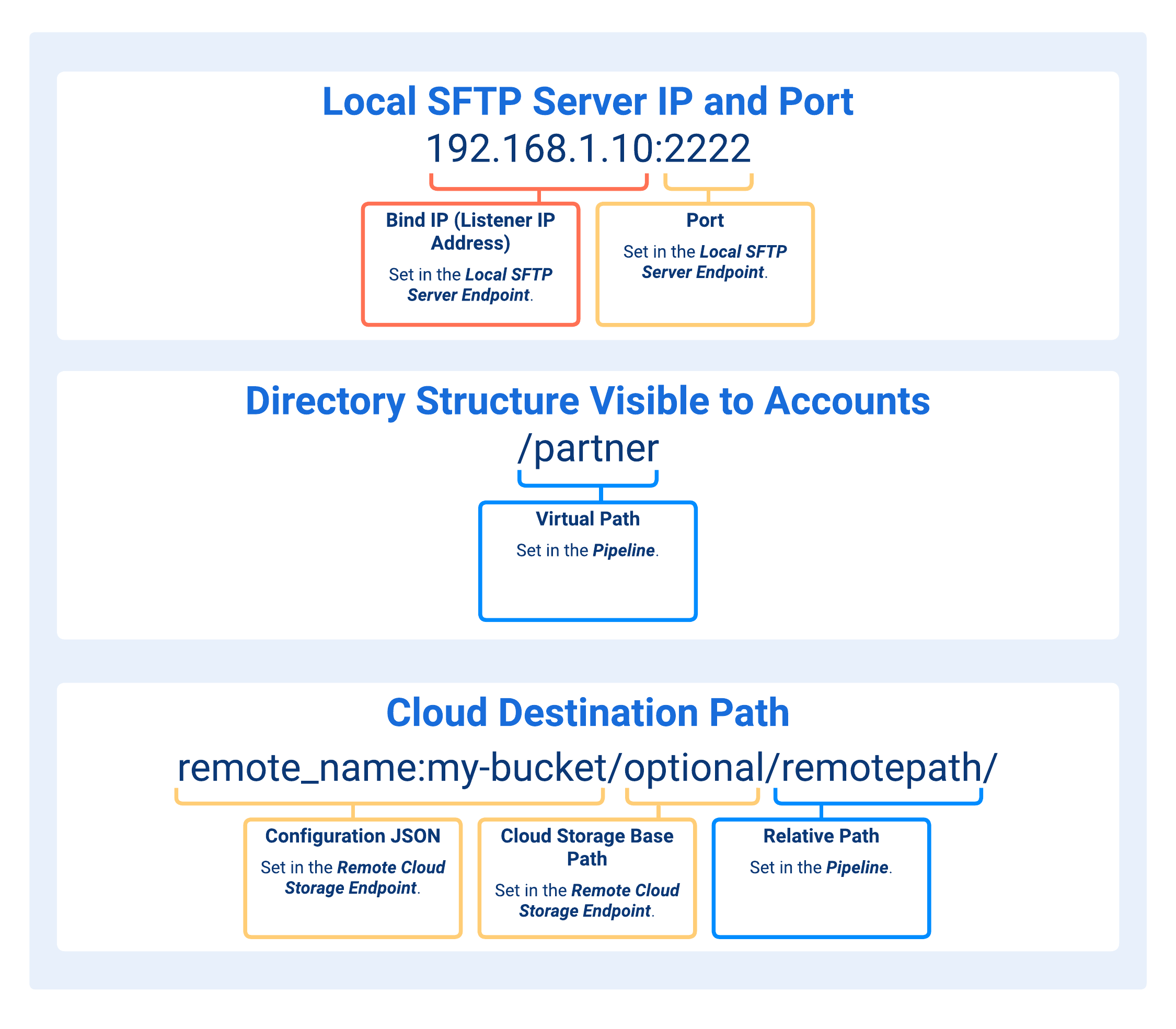
- Bind IP (Listener IP Address) and Port
- Virtual Path
- Configuration JSON
- Cloud Storage Base Path
- Relative Path
The Listener IP Address and Port define the local bind address and port where the UDMG Server listens for incoming SFTP connections for this Pipeline.
These values are configured in the Local SFTP Server Endpoint used as the Source Endpoint.
Depending on your network (load balancer, DNS, firewall/NAT rules, or use of USP), the partner-facing SFTP hostname (or public IP) and port may differ from the bind address configured on the Endpoint. In such cases, ensure that the partner is provided with the correct public-facing hostname (or public IP) and port to reach your UDMG SFTP Server.
The Virtual Path defines the directory path that an Account can see and browse when connecting to the UDMG SFTP Server.
Virtual Paths represent the partner-facing directory structure. They do not need to match the underlying filesystem layout used by the Pipeline.
An Account may see more than one Virtual Path, depending on how many Pipelines (with the same Local SFTP Server Endpoint as Source Endpoint) the Account can access. Each Virtual Path is associated with a specific Pipeline.
Valid formats:
//dirdir
Path segments cannot contain leading or trailing spaces, or consist entirely of spaces. For example, / Reports is not valid.
Regardless of the UDMG Server host operating system, the path must use forward slashes / (Linux path formatting). The path does not accept subdirectories (more than 1 level).
The Configuration JSON defined in the Remote Cloud Storage Endpoint provides the Rclone remote configuration for the selected cloud provider and object storage service.
The structure and required fields of the Configuration JSON depend on the selected cloud provider. For provider-specific examples and requirements, see Configuration JSON.
An optional path defined in the Remote Cloud Storage Endpoint that can be used to define the root location within the Endpoint. For object storage, this path is appended as a suffix to the bucket or container from the Configuration JSON.
Valid formats:
- Leave blank
dirdir/
For more details, see Cloud Storage Base Path.
A path where files are read from or written to within your remote cloud storage provider. This path is appended to the Cloud Storage Base Path to form the full path.
Valid formats:
/(empty path)/dir/dir/subdir/dir
The path definition can use Runtime Variables.
Regardless of the UDMG Server host operating system, the path must use forward slashes / (Linux path formatting).
Runtime Variables
UDMG allows dynamic Relative Paths using variables, which are expanded at runtime (when the transfer starts or when an SFTP command is executed).
Variables, for instance, allow you to set a common Relative Path for multiple Accounts, where each Account is redirected to its own private directory.
| Variable | Description | Category |
|---|---|---|
${SESSION_UUID} | The UUID of the current session. | Session |
${DOMAIN_UUID} | The UUID of the Domain associated with the session. | Domain |
${DOMAIN_NAME} | The name of the Domain associated with the session. | Domain |
${ENDPOINT_NAME} | The name of the Endpoint associated with the session. | Endpoint |
${ENDPOINT_UUID} | The UUID of the Endpoint associated with the session. | Endpoint |
${ACCOUNT_NAME} | The Account Name of the Account associated with the session. | Account |
${ACCOUNT_USERNAME} | The Username of the Account associated with the session. | Account |
${ACCOUNT_UUID} | The UUID of the Account associated with the session. | Account |
${ACCOUNT_EMAIL} | The Email of the Account associated with the session. Not required to be unique within a Domain. Resolves to an empty string if not set. | Account |
${ACCOUNT_FIRST_NAME} | The First Name of the Account associated with the session. Not required to be unique within a Domain. Resolves to an empty string if not set. | Account |
${ACCOUNT_LAST_NAME} | The Last Name of the Account associated with the session. Not required to be unique within a Domain. Resolves to an empty string if not set. | Account |
${YYYY} | The current year with four digits (e.g., 2024). | Date/Time |
${MM} | The current month with two digits (e.g., 09). | Date/Time |
${DD} | The current day of the month with two digits (e.g., 12). | Date/Time |
The following examples show how variables can be used to build dynamic Relative Paths:
/${ACCOUNT_USERNAME}/Input/${YYYY}/Processing/${DOMAIN_NAME}/${ACCOUNT_USERNAME}/${YYYY}/${MM}/${DD}
Account Authentication
Remote clients connecting to a Local SFTP Server Endpoint are authenticated using Accounts, each of which defines a unique set of credentials authorized to access one or more Pipelines. These Accounts can be created internally within UDMG or can be provisioned by an LDAP directory or SSO provider (see Authentication).
For authentication to succeed:
- The client must connect using credentials that match a configured Account.
- The Account must belong to an Account Group.
- The Account Group must be assigned to the Pipeline that will handle the transfer.
This layered approach ensures:
- Only clients with valid, known credentials can access the Local SFTP Server.
- Access is restricted to the Pipelines explicitly linked to the client's Account Group.
- Credentials are managed centrally via Account Groups, decoupled from individual Pipelines.
For detailed instructions on this topic, refer to the Accounts and Account Groups.
Permissions
The file and folder level permissions Accounts can perform are associated with the Relative Path.
The available permissions for this Pipeline are:
| Permission | Availability |
|---|---|
| Download/Read File | |
| Upload/Write File | |
| Overwrite File | |
| Delete File | |
| List File | |
| Make Directory | |
| Remove Directory | |
| Rename File | |
| Share File |
Partners using SFTP GUI clients should have List File permission to browse the directory properly. If List File is not included, partners may see empty folders, missing files, or inconsistent UI behavior.
Pipeline Workflow
The Pipeline Workflow toggle enables automated Task execution during the transfer lifecycle.
When enabled, UDMG Server executes the Tasks associated with the Pipeline Workflow when specific transfer triggers occur.
Tasks are configured separately and can perform actions such as executing system commands or publishing Universal Events to Universal Controller. Multiple Tasks can be executed as part of a workflow, and they run sequentially in the order defined for the Pipeline.
For more information, see Tasks.
Adding a Pipeline
To add a Local SFTP Server to Remote Cloud Storage Pipeline, follow these steps:
- From the Sidebar, select Configuration > Pipelines.
- Click Add Pipeline.
- Complete the Name for the new Pipeline.
- Select the Source Endpoint with a Local SFTP Server Endpoint type.
- Select the Destination Endpoint with a Remote Cloud Storage Endpoint type.
- Fill out the dynamic fields following the Field Descriptions table.
- Click Add.
UDMG does not allow identical Pipelines to be created, even if they have different names. For more information, see Pipeline Validation.
Field Descriptions
The following table describes the fields that are configured for the Pipeline:
| Name | Description | Specifications | Required |
|---|---|---|---|
| Name | Name of the Pipeline. info Using a descriptive name makes the association of Pipelines to Account Groups easier. |
| Yes |
| Description | The description of the Pipeline. | No | |
| Business Service | Assigning a Business Service to this Pipeline restricts updating, deleting, and other actions so only Users with the same Business Service can perform them (role permissions still apply). For details, see Business Services. |
| No |
| Source Endpoint | The Source Endpoint is where files are retrieved, originated, or come from. |
| Yes |
| Destination Endpoint | The Destination Endpoint is where files are delivered to or sent. Allowable Destination Endpoints are based on the available Pipeline combinations. |
| Yes |
| Virtual Path | The path that is the directory structure visible to an Account upon login. It does not directly correspond to the cloud storage structure. For more information, see Understanding Paths. |
| Yes |
| Relative Path | A path where files are read from or written to within your remote cloud storage provider. This path is appended to the Cloud Storage Base Path to form the full directory path. For more information, see Understanding Paths. |
| Yes |
| Credentials Name | The client authentication Credentials used to authenticate to the cloud storage provider. For more information, see Remote Cloud Storage Authentication. | Must reference an existing Key Pair. | Yes |
| Permissions | The file and folder level permissions associated with the Relative Path. For all available options, see Permissions. | Default value: All available permissions. | Yes |
| Workflow Enabled | If enabled, the Pipeline Workflow is enabled and Tasks assigned on the Workflow tab will be executed. For more information, see Pipeline Workflow. | No |
Editing a Pipeline
To edit a Local SFTP Server to Remote Cloud Storage Pipeline, follow these steps:
- From the Sidebar, select Configuration > Pipelines.
- Click the Name of the Pipeline you want to edit.
- Click the Edit button above the Pipeline details.
- Edit details for the Pipeline.
- The Source Endpoint and Destination Endpoint cannot be changed after creation.
- Click Update.
Pipeline updates are subject to the same validation rules enforced during creation. For more information, see Pipeline Validation.
Pipeline changes are reflected immediately only for new connections. Ongoing client sessions are not affected until they reconnect.
Managing a Pipeline
All Pipelines support the ability to view the complete Pipeline and linked Endpoint details, including Account Group information.
Viewing Pipeline Details
To view the details of a Local SFTP Server to Remote Cloud Storage Pipeline, follow these steps:
- From the Sidebar, select Configuration > Pipelines.
- Click the Name of the Pipeline you want to view.
- Click the Overview tab or Details tab to see additional Pipeline and Endpoint details.
Pipeline Metadata
Pipeline details include all parameters given in the Field Descriptions table, plus the following read-only metadata:
| Name | Description |
|---|---|
| UUID | The universally unique identifier of this Pipeline. |
| Version | Version number of the configuration. Every change increases the number. |
| Enabled | Pipeline's Enabled status. If enabled, field is set to True. |
| Created | Date and time this Pipeline was created. |
| Updated | Date and time this Pipeline was last updated. |
Enabling and Disabling Pipelines
Pipelines can be Enabled or Disabled to control their active status and ability to participate in file transfers. The status is defaulted to Enabled and can be changed after creation. The Configuration Item's Disabled status does not impact whether it can be configured. Also, Disabled Endpoints can be added to a Pipeline.
- Enabled (default): The Pipeline is active and allows file transfers.
- Disabled: The Pipeline is inactive and does not allow file transfers.
To enable or disable a Pipeline, follow these steps:
- From the Sidebar, select Configuration > Pipelines.
- Click the Name of the Pipeline you want to enable or disable.
- Click the Enable or Disable button above the Pipeline details.
- If the Pipeline is Disabled, then the button displays Enabled. If the Pipeline is Enabled, then the button displays Disabled.
- Click Update.
Changes to a Pipeline's Enabled/Disabled status take effect immediately for new connections. Existing client sessions continue unaffected until they reconnect.
Assigning a Task to a Pipeline
To assign a Task to a Pipeline, follow these steps:
- From the sidebar, select Configuration > Pipelines.
- Click the Name of the Pipeline to which you want to assign a Task.
- Click the Workflow tab.
- The Workflow editor displays five columns:
- Available Tasks
- On Staged Tasks
- On Sent Tasks
- On Received Tasks
- On Error Tasks
- Drag and drop Task cards as needed:
- To assign the Task to the Pipeline Workflow, move a card from Available Tasks to one of the trigger columns.
- To unassign the Task from the Pipeline, click the x icon in the top right corner on the Task card.
- Click Cancel to discard all changes.
- Click Update.
Not all Task trigger columns are available for every Pipeline type. For this Pipeline type, the following column is not available: On Staged. For more information, see Task Triggers.
Deleting a Pipeline
To delete a Local SFTP Server to Remote Cloud Storage Pipeline, follow these steps:
- From the Sidebar, select Configuration > Pipelines.
- Click the Name of the Pipeline you want to delete.
- Click the Delete button above the Pipeline details.
- You will be asked to confirm the deletion. Click Continue.
UDMG prevents the deletion of a Configuration Item if it is currently referenced by another Configuration Item (i.e., Account Group). The Configuration Item must be edited or the reference removed before you can delete the Pipeline. Deletion cannot be undone.
Monitoring a Pipeline
To monitor and determine the status of a Pipeline, the Transfers page and Endpoints page must be monitored to track incoming Transfers and the Source and Destination Endpoints' individual statuses, respectively. If an Endpoint (Local SFTP Server) goes down (Endpoint Status <> Running), then all of the associated Pipelines, Account Groups, and Accounts are impacted.
On the Transfers page, the following fields indicate the type of Local Transfer.
- Is Schedule: If No, then the Transfer was a Local Transfer.
- Is Send:
- If No, then the Account uploaded a file to UDMG
- If Yes, then the Account downloaded a file from UDMG.
- Protocol: If SFTP-Cloud, then the Transfer was using this type of Pipeline.